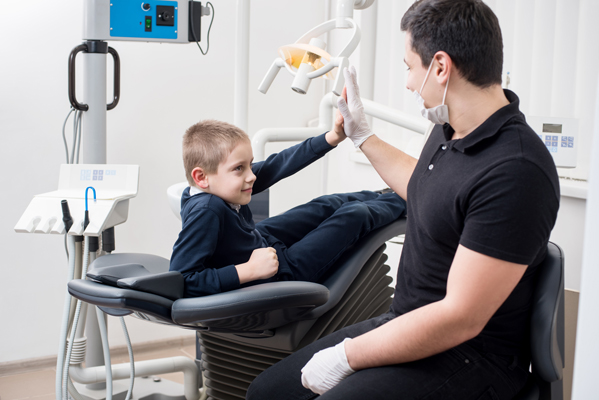
Children's tooth care is an essential part of promoting strong teeth and healthy gums throughout your little one's life. When you work with a pediatric dentist, you can help your child establish habits when they are young. These foundational habits that support children's tooth care can prevent cavities, gum disease, and the need for expensive dental treatments in the future.
The importance of teaching kids early oral hygiene
Children's tooth care begins before the first tooth erupts. Parents can wipe their infant's gums with a soft, damp cloth to help remove bacteria and introduce the concept of oral hygiene. Once their primary (baby) teeth appear, parents can help them brush with a soft-bristled toothbrush and a pea-size amount of kid-friendly fluoride toothpaste. They should also begin flossing as soon as two teeth touch each other. Daily flossing removes food particles and plaque between teeth where toothbrushes cannot reach.
Establishing good oral hygiene routines in young children can help them feel more comfortable during dental visits and foster positive habits for life. The American Academy of Pediatric Dentistry advises that children should have their first dental checkup by the time they are one year old or within six months. These appointments enable pediatric dentists to monitor their patients' dental development and offer guidance on proper oral care between appointments.
Recognizing the early signs of gum issues
Gum health is another crucial aspect of children's oral care. Parents and caregivers should be aware of the signs and symptoms of gingivitis, such as:
- Red, swollen, or tender gums
- Gums that bleed easily, especially during brushing or flossing
- Bad breath that does not go away
- Gums that appear to be shrinking or receding from the teeth
- Loose or shifting permanent teeth
These may indicate gingivitis or other periodontal concerns that require immediate attention from a dental professional.
Preventive dental services
Routine dental visits support ongoing oral health by providing preventive services. For example, dental cleanings remove plaque buildup that daily brushing may miss. Pediatric dentists also offer preventive treatments, such as fluoride treatments and dental sealants.
Fluoride treatments involve the use of gels or varnishes that the dentist applies to the child's teeth in a quick and painless procedure after a dental cleaning. These treatments remineralize enamel, making teeth more resistant to decay. Dental sealants are a preventive treatment that offers a protective coating on the chewing surfaces of the child's back molars. This area is more susceptible to cavities due to the deep grooves that trap bacteria and food debris, allowing them to accumulate.
Additionally, regular dental exams enable the pediatric dentist to identify gum problems at their earliest stage and recommend the most suitable treatment, such as a dental deep cleaning. Early diagnosis and treatment can prevent the disease from progressing and preserve the health of the surrounding teeth and soft tissues.
Learn more about the importance of children's tooth care and gum health
Children's tooth care is more than just kids keeping their teeth clean. It also includes helping them maintain their gum health and reinforce good habits. Call our Watertown office to learn more about how at-home and professional children's tooth care can help your child build healthy habits and keep their smiles bright.
Request an appointment here: https://pediatric-dental-arts.com or call Pediatric Dental Arts at (617) 924-1911 for an appointment in our Watertown office.
Check out what others are saying about our services on Yelp: Read our Yelp reviews.
Recent Posts
Using digital X-rays in pediatric dentistry is one of the simplest ways to assess children’s teeth for small changes over time and identify disease in the early stages. In addition to being easily accessible on a computer screen, digital X-rays are thought to be safer because these images require less radiation than traditional X-rays. Digital…
Kids' dental crowns protect weakened baby teeth so children can chew comfortably and speak clearly. When a cavity is too large for a filling, kids' dental crowns cover the remaining structure and restore everyday function. They also help maintain space for incoming adult teeth, which supports normal alignment and jaw development. A general dentist evaluates…
A children's dentist will tell you that tooth decay is the most common oral condition that affects kids. Any tooth can get tooth decay if it has erupted on the jaw, meaning that toddlers as young as six months can get cavities. This article provides information on the causes and prevention of tooth decay in…
A baby root canal may sound scary, however, it is nothing to be afraid of. Modern-day dentistry has allowed for the evolution of gentler techniques and safer approaches, thus reducing the risk of complications and pain during the procedure.Baby root canals, in particular, are done differently as they are performed in a pediatric dentistry setting,…